download your free guide
newborn sleep & feeding essentials: a new parent's survival guide
Worried about sleepless nights and feeding your baby? Grab your free Survival Guide today!
"*" indicates required fields

Babywearing is not a fad
Let’s talk about babywearing! No, it’s not just a trendy, natural mamma fad. It is physiologically important for the health and well-being of the mother-baby pair, particularly in the early postpartum period.
Babywearing has been practiced for centuries across cultures, from African kanga wraps to Asian mei tais to Latin American rebozos. Far from a parenting trend, it’s a time-honored way of staying connected to your baby while still engaging in daily life. Today, many families are rediscovering babywearing as both a bonding tool and a practical parenting solution.
Babywearing And Co-Regulation (What’s Co-Regulation Anyway?)
Most of us have heard of the importance of skin-to-skin contact in the first few hours post-birth, but did you know how deeply important ongoing co-regulation through physical contact is?
Co-regulation is the process of a baby and primary caregiver both contributing to the physiological regulation of various internal systems within each other, such as:
- temperature regulation
- heartbeat regulation
- blood circulation
- hormonal regulation
- emotional regulation
- respiratory and lung regulation
- and so much more!
This occurs when the mother and baby are in prolonged contact with one another.
Why Is Babywearing Good For Babies?
For the first 7-9 months of their lives, babies cannot biologically regulate these systems independently. Because of this, they actually experience serious dysregulation when separated from their mother.
Postpartum mothers cannot biologically regulate many of these systems for themselves without immediate contact with their baby for many weeks after birth. Any lactation consultant will tell you how much skin-to-skin helps with milk supply regulation.
Babywearing is one of the best ways to keep a close connection with your baby when you are out of the early postpartum period. In the early postpartum period, soft, flexible wraps can be the most comfortable for work around the house. More structured carriers can provide support for longer walks or more involved chores. These kinds of structured carriers are also a great option for women who do not find the soft, long wraps intuitive to use.
I recommend experimenting with several wraps until you find one that works well for you and your baby. Personally, I tried several wraps that I either received as gifts or purchased second-hand.
(By the way, stay tuned because I will review my favorite wraps in a future blog post!).

Types of Baby Carriers: Finding What Works for You
One of the beautiful things about babywearing is that there’s no one “right” way to do it. Different carriers work for different families, and what feels good in the newborn stage might not be your favorite six months later.
The key is finding something that supports both your baby’s body and your own comfort—while giving you the confidence to move through your day a little more freely.
Here’s a quick overview of the most common types of baby carriers and what they’re typically best suited for:
Stretchy Wraps
These are soft, long pieces of fabric (like the Moby or Boba Wrap) that you wrap and tie around your body. They’re especially cozy for newborns and offer a snug, womb-like feel. Stretchy wraps are ideal in those early postpartum weeks when your baby just wants to be close all the time.
Ring Slings
Ring slings are made from woven fabric and secured over one shoulder with a set of rings. They’re quick to put on and adjust, which makes them great for short trips, errands, or when you just need to calm your baby fast. They work well from the newborn stage through toddlerhood.
Soft-Structured Carriers (SSCs)
These buckle-style carriers (like the Ergo, Lillebaby, or Tula) have padded straps and adjustable waistbands. They’re especially supportive for longer walks or babywearing as your child grows. Many offer multiple carrying positions—front, back, and sometimes hip—and are often a go-to for families on the move.
Meh Dais & Hybrid Carriers
Meh Dais are traditional Asian-style carriers with a structured panel and long fabric straps that you tie around your body. Hybrid carriers combine features of wraps and buckle carriers for a customizable fit with added support. These can be great if you want the security of a structured carrier with the flexibility of a wrap.
Woven Wraps
Similar to stretchy wraps but made from sturdier woven material, these carriers can be used well into toddlerhood and offer an incredible range of carrying positions. They do have a bit of a learning curve, but many parents love how supportive and customizable they are once they get the hang of it.
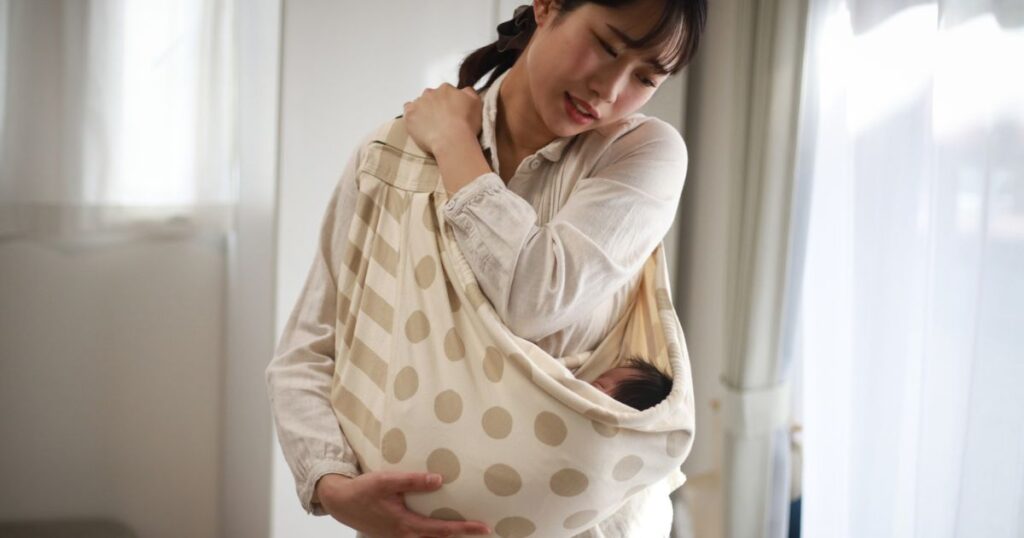
Babywearing Safety Basics
Babywearing is incredibly safe when done correctly. To make sure you’re carrying your baby safely, doing a few simple checks can make all the difference. A popular guideline to follow is the T.I.C.K.S. Rule:
- Tight: Your carrier should hold baby snugly against your body
- In View: Baby’s face should always be visible (yes, for gazing into their beautiful little eyes as well, that’s a bonus)
- Close Enough to Kiss: Their head should be high on your chest and close enough to kiss—yes, for safety, but newborn kisses are the best, hands down!
- Keep Chin Off Chest: Baby’s airway should be clear, with no slumping, so that they have ample room to breathe comfortably and without any straining or difficulty
- Supported Back: Their back should be well-supported in a natural position
Also, be sure your baby’s legs are in an “M” shape to support healthy hips, and that you feel physically comfortable too—no sharp shoulder or back strain. Finally, avoid risky activities like cooking or bending at the waist while babywearing.
With these babywearing safety basics in place, babywearing can be a safe, bonding experience for both of you.
Flexibility in the Fourth Trimester
One of the biggest benefits of babywearing in those early postpartum weeks is the freedom it offers. And many moms and parents will tell you this as well, trust me! When your baby wants to be close (which is quite literally most of the time), wearing them allows you to meet their need for connection while still having your hands free to move through daily life.
Whether it’s making yourself a meal, caring for an older sibling, or just walking around the block for some fresh air and quiet time, babywearing creates space to care for your baby and yourself. It can be especially helpful for parents recovering from birth who aren’t quite ready to juggle strollers or long outings.

The Bottom Line About Babywearing…
Babywearing doesn’t have to look perfect to be effective. It might take a few tries to figure out how to wrap, adjust, and carry comfortably, and that’s completely normal. It’s okay to feel unsure at first. Like all things in parenting, confidence comes with practice.
Feel free to reach out to me for tips and troubleshooting on how to wear your baby comfortably! You can get in touch with me here or by booking a free consultation.
PS: If you’re about to have a newborn soon, or you already have one and are looking for a bit of guidance and support, we have a free newborn guide for you!
PPS: Looking for Baby Carrier Recommendations?
We know the world of babywearing can feel overwhelming at first, so if you’re not sure which carrier to choose, you’re not alone. We’ve put together a helpful list of our favorite baby carriers for different needs and styles. (For longer hikes with baby, we highly recommend the Osprey Poco Premium Child Carrier.)


Meet Kaitlyn Foster, RN, PNP
Passionate Doula and Dedicated Healthcare Professional
Kaitlyn Foster is not only the visionary founder of Queen City Doulas but also a proud mother of two energetic boys. With a rich background as a Radical Birth Keeper, she brings a profound dedication to empowering and supporting families through the transformative journey of childbirth.
Kaitlyn’s expertise is further enhanced by her extensive healthcare experience; she is both a registered nurse and a pediatric nurse practitioner. Her unique blend of medical knowledge and passionate advocacy for natural birth experiences makes her a trusted ally to parents navigating the early stages of parenthood in the Charlotte area.
download your free guide
newborn sleep & feeding essentials: a new parent's survival guide
Worried about sleepless nights and feeding your baby? Grab your free copy of our Newborn Sleep & Feeding Survival Guide and start mastering the challenges of new parenthood today!